
Designated as Jahangirnagar after the reigning Mughal emperor Jahangir, seventeenth-century Dhaka was envisioned as a grand metropolis and the provincial capital of Bengal, one of the wealthiest provinces of the Mughal empire. In keeping with its importance, the city hosted men of the highest rank in the imperial nobility, including princes such as Shah Shuja (1639–1660) and powerful governors like Shaista Khan (1664–1678, 1679–1688). Contrary to the traditional belief in a highly centralised empire, these officials often exercised relative autonomy. Dhaka’s political, cultural, and material prosperity found its most vivid expression in its architecture—forts, mosques, palaces, and tombs—commissioned and embellished under their patronage.
The construction of siege forts and river forts under governors like Islam Khan (1608–1613) and Mir Jumla (1660–1663) gave way in the latter half of the seventeenth century to a flourishing of private and public architecture under Nawab Shaista Khan . Shaista Khan’s two-term viceroyalty not only ensured prolonged political stability but also left Dhaka with a legacy of buildings more profuse than that of any other Mughal subadar in Bengal. Among his architectural patronage, the tombs built for women—wives, concubines, daughters, and other female members of the elite—form a distinctive and culturally revealing category.
Shaista Khan’s Patronage and the Context of Tomb-Building
Shaista Khan, a veteran Mughal nobleman and maternal uncle to Emperor Aurangzeb, came to Bengal at the age of 63 and departed after 22 years in 1688. His tenure is remembered for military successes, expansion of trade, urban development, and extensive building activity. He used his resources not only for fortifications and public works but also for commemorative monuments.
Six notable tombs in Dhaka are attributed to his patronage for women identified as wives, concubines, or daughters: Bibi Pari, Bibi Champa, Lado Bibi, Dara Begum, Bibi Mariam, and an unnamed daughter buried near the Satgumbad Masjid. These tombs, though diverse in style and layout, collectively form part of the architectural narrative of Dhaka’s Mughal period. Their association with Shaista Khan is established through a combination of stylistic analysis, location, literary sources, and oral tradition.
The Mughal practice of honouring women with lavish monuments had precedents in the imperial capitals, such as the tomb of Anarkali in Lahore and that of Dai Anga, Jahangir’s wet nurse, built in 1671. These Dhaka tombs, therefore, reflect not only provincial imitation of imperial trends but also the local adaptation of commemorative architecture to Bengal’s climate, materials, and social context.
Problems of Identity and Authorship
One of the central challenges in studying these tombs is the absence of inscriptions. Without epigraphic evidence, attribution depends on circumstantial and stylistic markers. Only the tomb of Haji Khwaja Shahbaz can be securely identified and dated (1679 A.D.) through the inscription on its adjoining mosque.
In the case of Shaista Khan’s female tombs, identification often relies on oral history and later historical works. For instance, Bibi Champa is remembered as either his daughter or concubine, buried in the former courtyard of the Chota Katra; Lado Bibi’s tomb, now demolished, stood near a mosque believed to be Shaista Khan’s first in Dhaka; Dara Begum’s tomb, now the prayer chamber of the Lalmatia Jami Masjid, is traditionally linked to a daughter or the wife of a subadar. Bibi Mariam’s tomb at Hajiganj in Narayanganj is connected to Shaista Khan through its stylistic parallels with his other patronage.
The issue of authorship is also complicated by the Shaista Khani style—a late seventeenth-century architectural idiom found in both Dhaka and other Bengal sites, not always directly commissioned by him but by nobles in his circle. This makes it difficult to separate monuments built under his personal direction from those simply reflecting the style popularised during his tenure.
Tomb Types in Dhaka
Tomb architecture in Mughal Bengal offers variety, but in Dhaka the extant Mughal tombs fall into three principal categories:
1. Square tomb chamber with a single dome or segmented roof – Known as the canopy or qubba tomb, this is the earliest and most common Islamic tomb form. Structurally simple and inexpensive, it was popular in both the Sultani and Mughal periods. Examples in Dhaka include the tombs of Bibi Champa, Lado Bibi, and the Satgumbad Masjid tomb.
2. Single-domed square chamber with an attached verandah on the south – Similar to the first type but with a south-facing verandah, this form is seen in the tombs of Haji Khwaja Shahbaz and Dara Begum, with earlier and more elaborate parallels at Fatehpur Sikri.
3. Square tomb chamber surrounded by a continuous verandah or by chambers and passages – More elaborate and rare in Bengal, this type suits dynastic or family tombs. Bibi Pari’s tomb in Lalbagh Fort is the prime Dhaka example, with provincial parallels in the tomb of Shah Niamat Allah at Gaur.
Notable Tombs
Bibi Pari
Iran Dukht alias Bibi Pari, believed to be Shaista Khan’s favourite daughter and wife of Prince Muhammad Azam (Aurangzeb’s son), died in 1684.

Her tomb, situated in Lalbagh Fort, is exceptional for its materials—white marble from Jaipur, black basalt from Gaya, grey sandstone from Chunar—and for its lavish ornamentation, including glazed floral tiles and overlapping basalt slabs for ceilings. The copper dome, purely ornamental, crowns a building of balanced proportions and refined surface decoration.
Bibi Champa
Buried in the former courtyard of the Chota Katra, Bibi Champa’s tomb exemplifies the canopy type. Identified as either a daughter or concubine of Shaista Khan, her tomb was part of a residential-palatial complex, reflecting the integration of domestic and commemorative spaces in Mughal Dhaka.
Lado Bibi
Supposedly another daughter of Shaista Khan, Lado Bibi’s tomb once stood near a mosque in Babubazar. Demolished during the construction of the Mitford Hospital’s ladies’ ward, it is known through early descriptions and Charles D’Oyly’s illustrations, showing a canopy-type plan with refined proportions.
Dara Begum
Now incorporated into the Lalmatia Jami Masjid, Dara Begum’s tomb is a self-contained structure distinguished by its large dome and mihrab. Its location near the royal Pilkhanā suggests it was once part of a prominent Mughal residential quarter.
Bibi Mariam
At Hajiganj in Narayanganj, Bibi Mariam’s tomb stands within a walled complex alongside a mosque. Its proximity to the Mughal river fort indicates a strategic as well as commemorative function.
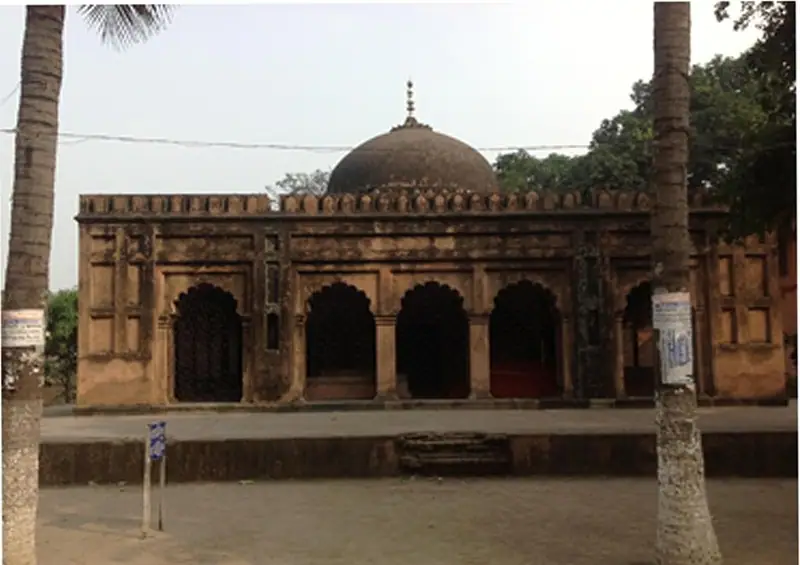
The southern side of the enclosure has been altered, but the original scheme reflects late Mughal provincial design.
The Satgumbad Tomb
Located near the Satgumbad Masjid, this elevated tomb is identified as belonging to Shaista Khan’s daughter. Its open setting and former garden layout mark it as part of a larger riverside complex on the Buriganga’s north bank.
Architectural Features and Materials
Mughal tombs in Dhaka share certain formal characteristics. The cube-shaped chamber, with its north–south axis and principal southern entrance, is the basic unit. Arched openings on the north and south are usually functional, while those on the west and east may be blind or perforated. Domes may be domical, vaulted, or flat-roofed. Verandahs and repetitive facades enhance the monumentality.
Decoration is applied with restraint yet precision—faceted plaster, sunken rectangular panels, recessed arches, and slender minarets rising from bulbous bases. In the case of Bibi Pari’s tomb, the richness is exceptional: polished plaster mimicking marble, multicoloured glazed tiles, and imported stone from across the Mughal empire.
The interiors are often radially symmetrical, with ornament applied to ceilings, spandrels, and wall panels. Materials were chosen both for availability and for symbolic value: marble for purity, basalt for strength, sandstone for durability. The use of overlapping basalt blocks in ceilings follows an old Hindu construction technique.
Symbolism, Function, and Setting
The location and setting of these tombs reveal their social and symbolic dimensions. Many, such as Bibi Champa’s and Lado Bibi’s, were integrated into palatial or residential compounds, signifying the personal and familial nature of commemoration. Others, like the Satgumbad tomb, occupied prominent sites along the Buriganga, connecting them to the city’s ceremonial and maritime life.
The arrangement of tombs within complexes—often alongside mosques, ghuslkhānas (bathing houses), and tanks—followed the imperial chahār bāgh garden-tomb tradition, though adapted to local topography and scale. Such complexes served both as places of burial and as spaces for ongoing acts of remembrance, prayer, and social gathering.
The Shaista Khani Style
The so-called Shaista Khani style represents the high point of late seventeenth-century Mughal architecture in Dhaka. Its hallmarks—three domes, three arches on facades, and corner kiosks—were not unique inventions but adaptations of an idiom already visible in the works of Shah Shuja at Rajmahal, Gaur, and Dhaka.
Shaista Khan’s contribution lay in the prolific application and refinement of this style, producing a body of work marked by structural balance, proportion, and ornamental restraint. His patronage extended beyond tombs to mosques, caravanserais (katras), and bridges, shaping the urban fabric of Dhaka for generations.
Cultural Context and the Commemoration of Women
The Mughal custom of raising monumental tombs for women of high status—wives, concubines, daughters, and even wet nurses—reflected both personal affection and the political display of power. In the imperial capitals, such patronage elevated the status of these women within courtly culture. In Dhaka, the practice signalled the city’s integration into broader Mughal ceremonial life.
That some tombs in Dhaka may have been built for women of high rank not belonging to Shaista Khan’s household suggests a wider circle of elite commemoration in the city. The architectural quality of such monuments indicates the wealth and cultural aspirations of Dhaka’s nobility.
Conclusion
The Mughal tombs of Dhaka stand today as architectural testaments to the city’s seventeenth-century prominence and to the cultural life fostered under Shaista Khan’s viceroyalty. In their forms—whether simple canopies, verandah-fronted chambers, or elaborate multi-chambered structures—they reveal a blend of imperial Mughal models and local Bengali adaptations.
They also open a window onto the social history of the period, especially the ways in which women of the Mughal elite were memorialised. The interplay of architecture, patronage, and commemoration in these monuments makes them invaluable not only to the study of Mughal Bengal but also to the heritage of Dhaka itself.
As silent yet eloquent witnesses to an era of political stability and architectural splendour, these tombs deserve continued scholarly attention and careful preservation. In their domes and arches, in their gardens and courtyards, they preserve the memory of a Dhaka that was once a jewel of the Mughal world.
Archival Note
The content on this page has been archived and curated by Shamsuddoza Sajen, Chief Archivist of Bangladesh on Record. He can be contacted at [email protected]
Sources
- Asma Serajuddin, “Mughal Tombs in Dhaka,” in Dhaka: Past Present Future, ed. Sharif Uddin Ahmed (Dhaka: The Asiatic Society of Bangladesh, 1991), 333–350.