
Early Life and Education
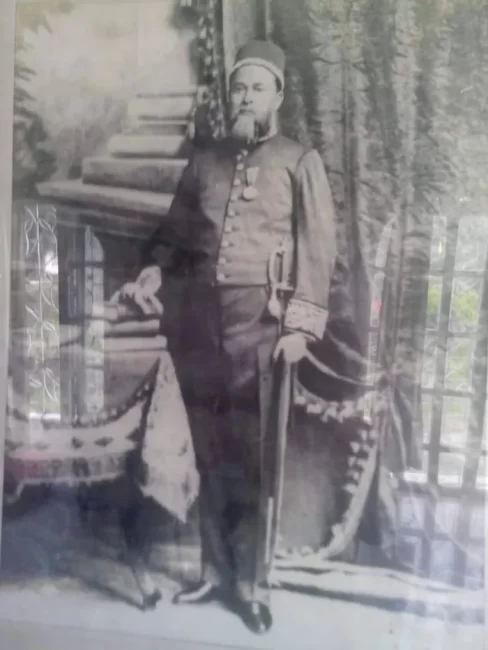
Born on December 29, 1863, at the residence of his maternal grandfather, Khan Bahadur Muhammad Ali Khan Chowdhury, a zamindar of Natore, Nawab Ali Chowdhury hailed from a lineage with deep roots in Bengal’s zamindari system. His father, Shah Syed Janab Ali Chowdhury, was a zamindar of the Dhanbari estate in Tangail, and his mother was Rabeya Khatun Chowdhurani. The family traced its ancestry to Shah Syed Khuda Bokhs, who settled in Dhanbari 250 years before Nawab Ali’s birth.
Nawab Ali received a robust education, beginning with tutoring in Arabic, Persian, and Bengali. He later attended Rajshahi Collegiate School and graduated from St. Xavier’s College in Calcutta. His proficiency in English, Urdu, Arabic, and Persian equipped him for a multifaceted career in public service and reform. Initially appointed as an Honorary Magistrate in Mymensingh, he soon relinquished the role to pursue a life dedicated to public welfare.
Political Career and Advocacy
Contributions to Education
Nawab Ali’s most enduring legacy is his contribution to the establishment of Dhaka University in 1921, a milestone in the educational history of Bangladesh. As a member of the Imperial Legislative Council, he piloted the Dhaka University Bill, navigating significant opposition to secure its passage. He played a crucial role in framing the university’s rules and regulations and provided financial support during its formative years. To fund the university, he mortgaged part of his zamindari estate, donating 35,000 taka, and contributed an additional 16,000 taka for student scholarships in Islamic Studies and other disciplines. His efforts earned him the distinction of being one of the university’s founders, and in 2003, the university’s senate building was renamed the “Syed Nawab Ali Chowdhury Building” in his honor.
Beyond Dhaka University, Nawab Ali supported 38 educational institutions across greater Mymensingh. In 1910, he established the Nawab Institute, a high school in Dhanbari, and facilitated the creation of hostels for Muslim students in Dhaka, Calcutta, and Mymensingh. In 1906, he donated 35,000 taka to establish a Muhammadan Hall for Muslim students at Dhaka College, reflecting his commitment to improving access to education for the Muslim community.
Philanthropy and Social Reform
Nawab Ali Chowdhury was a noted philanthropist whose contributions extended beyond education. His donations supported the construction of mosques, roads, and ponds, enhancing community infrastructure. He was a patron of Bengali language, literature, and journalism, owning and editing the weekly newspaper Mihir-o-Sudhakar from 1895. He also provided financial support to newspapers like Islam Pracharak (1891) and Pracharak (1899), fostering intellectual discourse. His literary works, including Vernacular Education in Bengal (1900), Eid-ul-Azha (1900), and Maulud Sharif (1903), underscored his advocacy for cultural and educational advancement.
As a social reformer, Nawab Ali championed the cause of Muslim upliftment, addressing issues of illiteracy and socio-economic backwardness. His efforts to promote vernacular education and his support for the Bengal Provincial Educational Society highlighted his vision for an educated and empowered society. His recognition by the British government with titles such as Khan Bahadur (1906), Nawab (1911), CIE (1918), and Nawab-Bahadur (1924) reflected his widespread influence and contributions.
Personal Life and Legacy
Nawab Ali Chowdhury married three times and had children, including Syed Hasan Ali Chowdhury, who followed in his father’s footsteps as a politician and minister in East Pakistan. His grandson, Muhammad Ali Bogra, served as the third Prime Minister of Pakistan, further extending the family’s legacy of public service.
Nawab Ali passed away on April 17, 1929, at Eden Castle in Darjeeling, at the age of 66. His death marked the end of an era, but his contributions continue to resonate. The Dhanbari Nawab Palace, partially established by him in 1919, remains a testament to his grandeur and influence, now maintained as a historical site and resort. Annual commemorations of his birth anniversary, marked by wreath-laying, Qurankhwani, and charitable activities, reflect the enduring respect for his legacy.