Title: The District of Bakarganj: Its History and Statistics
Author: H. Beveridge, B.C.S., Magistrate and Collector of Bákarganj
Publisher: Trübner & Co., Ludgate Hill, London
Year: 1876
Overview
Henry Beveridge’s The History and Statistics of Bákarganj is a meticulously compiled historical and statistical account of the Bákarganj (now Barisal) district in present-day Bangladesh, written during the British colonial period. Drawing from nearly five years of administrative experience in the district, supplemented by extensive research at the India Office and the British Museum, Beveridge aimed to produce a work that would serve as a practical resource for government officials and local inhabitants while contributing to the growing body of district histories in Bengal.
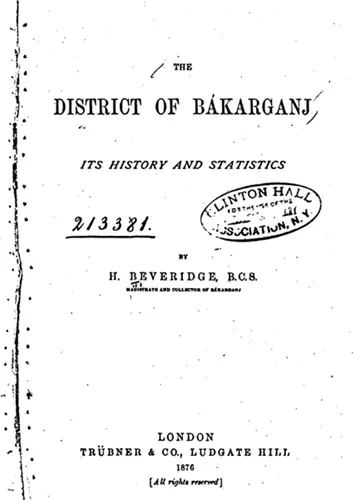
Published in 1876 by Trübner & Co., this book is a significant artifact of colonial scholarship, offering a detailed snapshot of Bákarganj’s geography, administration, economy, and society in the 19th century.
Content and Structure
The book is organized into three parts, reflecting Beveridge’s systematic approach:
Part I: The Land – This section covers the physical geography of Bákarganj, including its parganas (administrative subdivisions), the Sundarbans, and government estates. Beveridge provides detailed descriptions of land tenures and under-tenures, emphasizing administrative structures critical to colonial governance.
Part II: The People and Natural Productions – This part examines the district’s population, social conditions, and natural resources, though Beveridge deliberately avoids in-depth discussions of agricultural practices like rice cultivation, citing their commonality and tendency to become outdated.
Part III: Administration and Miscellaneous – This section traces the administrative history of Bákarganj, with chapters on specific topics such as the town of Barisal, the jail, and other local institutions.
A notable chapter, “General Remarks,” allows Beveridge to explore broader themes, including speculative discussions on India’s future, such as the potential for Indian self-governance and the gradual withdrawal of British rule. He quotes his father’s views on the moral imperative of “civilizing” India, even if it leads to independence, though Beveridge himself prefers the term “civilize” over “Christianize,” reflecting a nuanced perspective on colonial policy and missionary efforts.
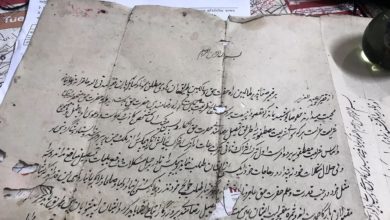
The book’s appendices are a treasure trove of primary sources, including historical documents like collectors’ reports from the Permanent Settlement era. However, Beveridge notes the imperfect condition of some records, such as letters from Messrs Douglas and Massie, and advocates for their preservation through government publication. His exploration of early European travelers’ accounts, such as those by Edward Barbosa and Nicolo de Conti, adds depth to the historical narrative, particularly in hypothesizing that the “city of Bengala” may refer to Gour in Maldaha.
Significance of The District of Bakarganj: Its History and Statistics
Beveridge’s work is a pioneering effort in the genre of district histories, inspired by models like Sir John Sinclair’s statistical accounts of Scotland. It joins other notable Bengal district studies, such as Francis Buchanan’s accounts of Rangpur and Dinajpur, Andrew Stirling’s work on Cuttack, and J.G. Westland’s report on Jessore.
Beveridge acknowledges the limitations of a foreigner writing about a Bengali district, advocating for native scholars to produce more comprehensive histories that capture local customs, castes, and social nuances. His humility in this regard underscores the book’s role as a foundational text meant to inspire further research.
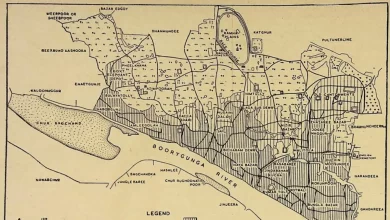
The book’s focus on Bákarganj’s parganas and official history reflects Beveridge’s administrative priorities, providing granular data on land revenue systems and governance that are invaluable for understanding colonial Bengal’s bureaucratic machinery. His cautious approach to spelling local names and his regret over inconsistent diacritical marks highlight the challenges of transliteration in colonial scholarship. The inclusion of a map, adapted from the Revenue Survey, enhances the book’s utility as a geographical reference.
Context and Limitations
Beveridge’s preface reveals his awareness of the book’s niche appeal, noting that much of its content may not interest general readers. His reluctance to delve into agricultural practices or social customs stems from a belief that these are either too universal or ephemeral to warrant detailed treatment. While this decision preserves the book’s focus on administrative history, it leaves gaps in ethnographic and economic detail that a native author might have filled. His speculative remarks on India’s future, while thought-provoking, may seem tangential to some readers, though they reflect the intellectual currents of his time.
To request a digital copy of the book, please email [email protected] or send a WhatsApp message to +8801728471997.